
The Silicon Valley Overlords are Jumping the Rationalist Shark
They're invoking other forms of intelligence and praying more ardently than a peasant woman who's just seen a ghost. We need a wit like Rabelais to strike them down . . . and quickly.
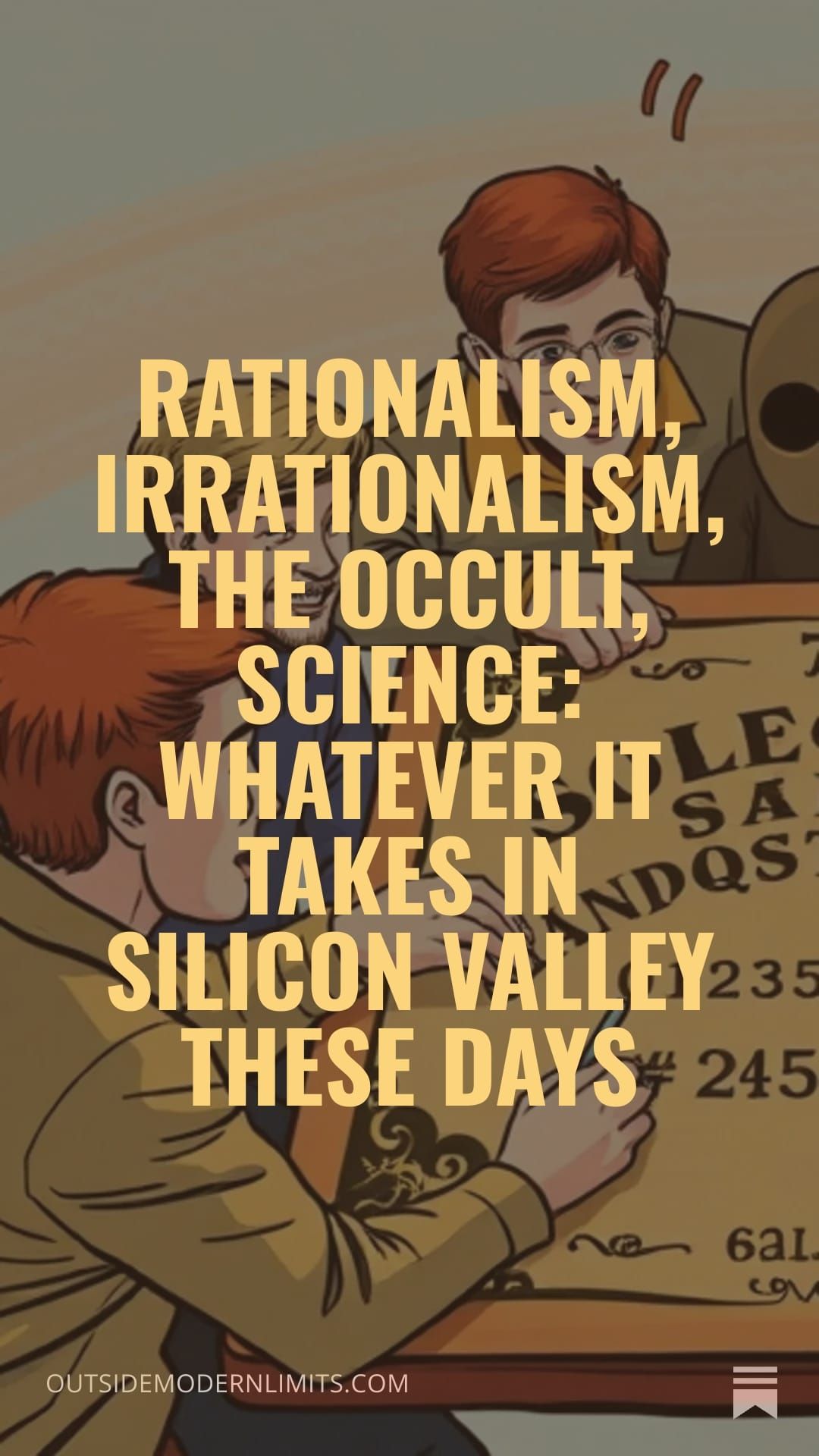
Talismans slap.
Gotta hangover that won't stop? Carve the image of Elvis in a yellow cape sitting in front of the sun. Is Peter Attia's advice for living to 100 too arduous? That's alright. Make an image of Saturn on sapphire: you'll reach 103, easily.
No matter what the ailment, no matter what the goal, the talisman's gotcha covered better than that afghan your grandma crocheted for Christmas with off-hue red and green yarn that she got from the bargain bin.
Even better, you can supercharge your talisman and use it for grand things. Wielding it like a sledgehammer against your enemies, for instance, then wiping it off and using it to make Sydney Sweeney your love toy for the night.
You just gotta lace your talisman with a god.
That's it.
You can find the god-trapping instructions in the Arabic Picatrix, a twelfth-century grimoire that described talismanic methods in great detail. The text was sacred script among the Renaissance magicians like Pico Mirandola, who kept a copy in his personal library.
Don't feel like downloading Duolingo and learning Arabic? That's alright. You can read the Latin translation. Still too rigorous? You can read free English translations online.
But if you want to bypass effort altogether, maybe you can ask Grok or Claude to short-cut it for you.
That's what today's hermeticists are doing.
Rumors seeping out of Silicon Valley say it's become a coven of psychonauts using and invoking supra-rational intelligence to give them technological power. Specifically, they seek artificial intelligence laced with a god. It's called "artificial super intelligence" or a machine with "consciousness."
I'm not sure they care what supra-rational intelligence they trap in their talisman. They're open to anything. They buy psychedelics by the blotter. If UFOs show up with a manual, they'll buy a copy. Some are channeling the Egyptian god Thoth. I think they're even open to the supra-rational knowledge provided by mushrooms and their fungal underground . . . at least I know they're open to psilocybin.
These minions of our Silicon Valley overlords– and maybe the overlords themselves--are grabbing at deities like those clowns in the glass money booth with greenbacks flying around, trying to grab as many pieces as possible before the clock stops.
But with a crucial difference: When that clown walks out of the booth with $247 and sweaty armpits, he drinks off his degradation at the bar.
Those Silicon Valley wizards aren't drinking off shit. They're relishing it and doubling down as AI grows, "the Singularity" gets closer, and they feel themselves mere inches from shoving those talismans up everyone else's ass: conquering the world, defeating mortality, and bedding every Sydney Sweeney (not necessarily in that order).
Albert Jay Nock didn't have much use for such things. The former Episcopalian priest never rejected Christianity but neither did he have much respect for its organized forms. He became one of the most enigmatic popular writers of the 1920s and 1930s. A man with a mysterious past and even more mysterious present, his entire existence was dedicated to one thing: being left the f' alone.
Well, that, and developing the finest American prose style since Henry Adams and using that prose to thrust spears into every sacred cow of the inter-war period. If the definition of a "dick" is someone who makes fun of things others take seriously, Nock and his contemporary, H.L. Mencken, were the big ones of their day.
As near as I can tell, Nock revered only one thing: Francis Rabelais, the 16th-century author of the satirical masterpiece, Gargantua and Pantagruel. Nock revered Rabelais because Rabelais revered nothing. Like Nock, he was a Christian (and former cleric) who didn't take his era's religious forms very seriously.
Like Nock, Rabelais mocked every excess . . . every artifice or idea that took on sacred form . . . every form of hubris.
Gargantua and Pantagruel was the South Park of the 16th century.
He wrote his masterpiece during the bubbliest era of Renaissance magic, and he ridiculed the practices like he did every sacred cow back then.
But he seemed to have a special scorn for the magical pursuits.
Nestled in book three of GP, Rabelais referred to "the Reverend Father in Devil Picatris, rector of the diabolical faculty."
The Devil Picatris? Diabolical?
Was it just part of Rabelais' rhetorical excess of hilarity and not to be taken seriously?
Or did he see--sense--that those magicians weren't just jacking around with empty superstition but really were invoking something sinister?
It beats me, but we probably need to start dropping copies of Gargantua and Pantagruel into Silicon Valley like we dropped bundles of food into West Berlin during the 1948 airlift. If nothing else, Rabelais' slashing satire might give those minions at least a little reprieve from their hubris . . . and save us from whatever hell on earth they're unleashing.